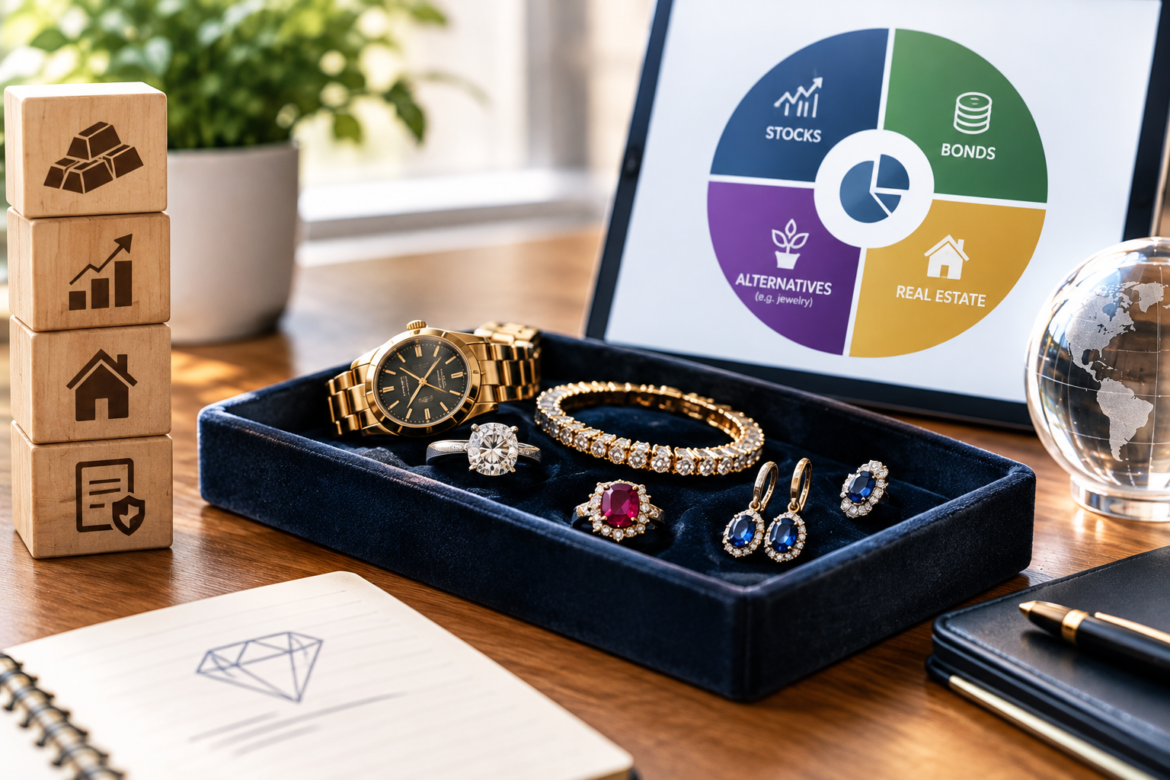
Yes—jewelry can be a form of portfolio diversification, especially when it is made from precious metals such as gold, silver, or platinum and includes high-quality gemstones. However, it should usually be treated as a small, long-term alternative asset rather than a replacement for stocks, bonds, mutual funds, or real estate.
Jewelry offers something many investments do not: you can wear it, gift it, and enjoy it while it potentially holds value. But it also comes with resale costs, storage needs, insurance expenses, and a market that can be difficult to navigate. The key is knowing which pieces to buy, how much to allocate, and what jewelry can realistically do for your overall financial plan.
What Portfolio Diversification Really Means
Portfolio diversification means spreading your money across different types of assets so that one poor-performing investment does not damage your entire financial position. Instead of putting everything into one stock, one business, or one property, you divide your investments among assets that may respond differently to economic changes.
For example, stocks may rise when the economy is strong, while gold and other precious metals are often viewed as stores of value during uncertainty. Bonds may provide steadier income, while real estate can generate rental income and long-term appreciation. The goal is not to eliminate risk completely—it is to reduce the chance that all your assets fall at the same time.
Jewelry fits into this idea because it is a tangible asset. Unlike a digital investment, you can physically hold it. Its value may be influenced by the price of gold, silver, platinum, diamonds, and rare gemstones, as well as craftsmanship, brand reputation, condition, and collector demand.
That said, jewelry is not automatically diversified just because it is expensive. A mass-produced piece bought at a high retail markup may lose significant value the moment it leaves the store. To diversify effectively, the jewelry needs to have qualities that support long-term value.
Why Jewelry Can Help Diversify a Portfolio
Jewelry can add diversification because its value does not depend only on stock market performance. It has characteristics that are different from traditional financial assets, which may make it useful as a small part of a broader investment mix.
It Is a Tangible Asset
Jewelry is something you can see, touch, wear, and pass down. This physical nature can be appealing to investors who want an asset outside of bank accounts, stock portfolios, or digital platforms.
Gold jewelry, in particular, has intrinsic value because of its metal content. While the design and brand may add to the price, the underlying gold can still hold value even if fashion trends change.
It May Act as a Store of Value
Precious metals have long been considered potential hedges against inflation and economic uncertainty. Gold, in particular, is often sought during periods when investors are worried about currency weakness, market volatility, or geopolitical instability.
Jewelry made primarily from gold may benefit from this same underlying value. However, it is important to separate the value of the metal from the value of the finished piece. A necklace may contain gold worth a certain amount, but its resale price can be much lower than what you originally paid because of retail markup, design costs, and dealer margins.
It Can Have Emotional and Practical Value
Unlike many investments, jewelry can be enjoyed every day. You can wear it to special events, give it as a gift, or pass it on to family members. This does not necessarily make it a better investment, but it does make it different from stocks or bonds.
Some investors choose high-quality jewelry because they want an asset that has both financial and personal meaning. The best approach is to buy pieces you genuinely appreciate, rather than treating every purchase as a guaranteed profit opportunity.
It May Offer Exposure to Luxury and Collectible Markets
Fine jewelry, antique pieces, signed designer jewelry, and rare gemstones can sometimes behave more like collectibles. Their value may be influenced by scarcity, historical importance, designer reputation, condition, and demand from collectors.
This means jewelry can provide exposure to markets beyond the usual stock-and-bond mix. Still, collectible markets can be unpredictable. Just because a piece is old, beautiful, or branded does not automatically mean it will increase in value.
The Risks of Investing in Jewelry
Jewelry can diversify a portfolio, but it is not a risk-free investment. In fact, it has several drawbacks that investors should understand before spending large amounts of money.
Retail Markups Can Be High
One of the biggest challenges with jewelry is the difference between the purchase price and resale value. When you buy jewelry from a retail store, you often pay for more than just the metal or gemstones. You may also be paying for design, branding, craftsmanship, packaging, marketing, and store overhead.
This means a piece purchased at full retail price may be worth much less if you try to sell it soon afterward. Experts note that jewelry can carry substantial markups over the underlying value of its materials, especially when bought at regular retail prices.
Jewelry Is Not Very Liquid
Liquidity refers to how quickly and easily you can sell an asset without losing much value. Stocks and exchange-traded funds are generally highly liquid because they can often be sold within moments during market hours.
Jewelry is different. Finding the right buyer can take time, and you may need to work with a jeweler, auction house, pawnshop, dealer, or private buyer. Each option may offer a different price, and some may take a significant commission. Jewelry is generally less liquid than gold bullion, and transaction costs can be higher.
Prices Can Be Difficult to Determine
Unlike gold bars, which are usually priced based on weight and purity, jewelry values can be subjective. Two similar-looking diamond rings may have very different values depending on cut, clarity, color, carat weight, certification, setting, brand, and overall condition.
Gemstones can be especially complicated. A diamond’s value depends on widely recognized quality factors, while colored gemstones may depend even more on rarity, origin, treatment, and collector interest. This makes professional appraisal and documentation important.
Storage, Insurance, and Security Cost Money
Jewelry is portable, but that also makes it vulnerable to theft or loss. If you own valuable pieces, you may need a safe, secure storage option, insurance coverage, and occasional professional cleaning or maintenance.
These costs reduce your overall return. Unlike a rental property that may generate monthly income or dividend-paying stocks that provide cash payments, jewelry does not produce income while you own it.
Fashion Trends Can Affect Demand
Jewelry is partly a fashion product. Styles that are popular today may not be as desirable in ten or twenty years. While classic designs, high-quality metals, and rare gemstones may hold value better than trendy pieces, no jewelry purchase is guaranteed to appreciate.
This is why jewelry should not be your main investment strategy. It works best as a supplement to a diversified portfolio, not as the foundation of one.
What Types of Jewelry Are More Likely to Hold Value?
Not all jewelry is created equal. If your goal is portfolio diversification, focus on pieces with strong underlying value, verified quality, and lasting demand.
Gold Jewelry
Gold jewelry is often the most straightforward category for investment-minded buyers. Its value is tied partly to the market price of gold, which gives it a clearer baseline than fashion-driven costume jewelry.
When buying gold jewelry, pay attention to:
- Gold purity, such as 14K, 18K, 22K, or 24K
- Weight
- Current gold market price
- Craftsmanship
- Brand or designer reputation
- Resale demand
Keep in mind that 24K gold is purer but softer, while 14K and 18K gold are more durable for everyday wear. The best investment choice depends on whether you prioritize metal content, durability, or design.
Platinum Jewelry
Platinum is rarer than gold and is often used in high-end jewelry. It is durable, naturally white, and popular for engagement rings and fine jewelry. Like gold, platinum has intrinsic metal value, although its market price can fluctuate.
Platinum may appeal to investors who want a precious metal alternative to gold. However, it is still subject to resale spreads, craftsmanship costs, and market demand.
High-Quality Diamonds
Diamonds can hold value, but they are not always easy to resell at a profit. The famous “four Cs”—cut, color, clarity, and carat weight—play a major role in determining value. Certification from a reputable grading laboratory is also important.
For investment purposes, larger, high-quality, certified diamonds may have better resale potential than small, lower-quality stones. Still, diamonds can be difficult to price and sell, so they should not be treated like a liquid financial asset.
Rare Gemstones
Colored gemstones such as rubies, sapphires, emeralds, and certain rare stones can sometimes appreciate in value, particularly when they are untreated, high quality, and sourced from desirable locations. However, this is a specialized market that requires expertise.
Beginners should be especially careful with gemstones. Treatments, synthetic stones, and inaccurate descriptions can make it hard to know what you are buying. Independent certification and a trusted appraiser are essential.
Vintage, Antique, and Designer Jewelry
Well-preserved vintage and antique jewelry can attract collectors, especially if it features rare materials, distinctive craftsmanship, or a recognizable designer. Signed pieces from respected jewelry houses may also carry premium value.
However, authenticity matters enormously. Reproductions, altered pieces, and poorly documented antiques can be difficult to value. If you are considering this category, buy from reputable dealers and request detailed documentation.
Jewelry vs. Gold Bullion: Which Is Better for Diversification?
If your main goal is financial diversification, gold bullion is usually simpler than jewelry. Bullion bars and coins are valued primarily by weight and purity, making them easier to price, buy, and sell.
Jewelry, on the other hand, combines metal value with design, craftsmanship, and sometimes gemstones. That can make it more enjoyable, but also more complicated as an investment.
| Factor | Jewelry | Gold Bullion |
|---|---|---|
| Main value driver | Metal, gemstones, design, brand, condition | Metal weight and purity |
| Ease of pricing | More difficult | Easier |
| Resale process | Can be slow and subjective | Usually more straightforward |
| Retail markup | Often higher | Usually lower |
| Enjoyment value | Can be worn and enjoyed | Mostly stored |
| Income potential | None | None |
| Best role | Small alternative or collectible allocation | More direct precious-metals exposure |
Jewelry may make sense if you want an asset you can wear and enjoy. Bullion may make more sense if your priority is straightforward exposure to gold prices.
How Much of Your Portfolio Should Be in Jewelry?
There is no universal percentage that works for everyone. However, many financial professionals view alternative assets such as jewelry, art, watches, and collectibles as supplemental investments rather than core holdings.
A cautious approach is to keep jewelry to a small portion of your overall net worth—often only what you could afford to hold for many years without needing to sell quickly. Your core portfolio should still include more liquid and income-producing assets, such as stocks, bonds, index funds, retirement accounts, and possibly real estate.
Before buying, ask yourself:
- Can I afford this purchase without affecting my emergency fund?
- Do I plan to keep it for at least five to ten years?
- Am I buying because I like the piece, or only because I expect it to rise in value?
- Have I compared prices from multiple reputable sellers?
- Do I understand the resale market and potential transaction costs?
- Can I properly store and insure it?
If the answer to the last few questions is unclear, it may be better to start with a smaller purchase or consider gold bullion instead.
How to Invest in Jewelry More Wisely
If you decide to add jewelry to your portfolio, treat it like any other alternative investment: do your research, buy quality, and avoid emotional impulse purchases.
Buy From Reputable Sellers
Choose established jewelers, auction houses, certified dealers, or reputable estate-sale specialists. Check reviews, return policies, certifications, and the seller’s history. Avoid deals that seem too good to be true.
Request Documentation
Ask for receipts, certificates, appraisals, gemstone reports, and details about metal purity. For diamonds and colored gemstones, independent grading reports are especially valuable.
Documentation helps establish authenticity, supports insurance claims, and makes future resale easier.
Get an Independent Appraisal
A professional appraisal can help you understand the replacement value, resale value, and condition of a piece. It is especially important for high-value jewelry, antiques, and gemstones.
Keep in mind that an appraisal for insurance purposes may differ from a realistic resale estimate. Insurance appraisals often reflect the cost to replace an item, not necessarily the amount a dealer would pay to buy it from you.
Focus on Quality Over Trends
Classic designs, excellent craftsmanship, high-purity metals, and certified gemstones are generally safer choices than trendy pieces. A simple, well-made gold bracelet may be easier to resell than an elaborate design tied to a short-lived fashion trend.
Consider Estate Sales and Auctions
Some buyers find better value through estate sales, auctions, and pre-owned jewelry markets because retail markups may be lower. However, these purchases require extra care. Always verify authenticity, condition, and pricing before buying.
Insure Valuable Pieces
If you own jewelry worth a meaningful amount, homeowner’s insurance may not provide enough coverage. Look into specialized jewelry insurance or a rider on your existing policy. Keep photographs, receipts, appraisals, and certificates in a secure place.
When Jewelry Makes Sense as an Investment
Jewelry can be a reasonable diversification choice when:
- You already have a solid core portfolio
- You are buying high-quality pieces with lasting value
- You plan to hold them long term
- You understand resale costs and market risks
- You enjoy owning and wearing the pieces
- You are comfortable treating it as a supplemental asset, not a guaranteed investment
It can also make sense for people who want a portable store of value. High-quality gold jewelry, for instance, can be worn, transported, gifted, and potentially sold later. But it should still be viewed as a wearable asset first and an investment second.
When Jewelry May Not Be the Right Choice
Jewelry may not be the best option if:
- You need quick access to cash
- You expect guaranteed returns
- You are buying at full retail price with no resale plan
- You do not want to deal with insurance, storage, or appraisals
- You are relying on it as your main retirement strategy
- You are choosing pieces based only on appearance or emotional appeal
For investors who want diversification with easier pricing and resale, gold bullion, broad-market index funds, bonds, or real estate investment options may be more practical. Jewelry can still have a place, but it should not carry too much weight in your financial plan.
Jewelry as Investment
Investing in jewelry can be a form of portfolio diversification, but only when it is approached carefully. High-quality gold, platinum, certified diamonds, rare gemstones, and collectible designer pieces may add a tangible, nontraditional element to your investments.
The most important thing is balance. Jewelry can be beautiful, meaningful, and potentially valuable, but it is usually less liquid, harder to price, and more expensive to resell than traditional investments. Treat it as a small part of a well-rounded portfolio—something you can enjoy now while potentially preserving value over time.