Discover a Secret World
of Beautiful Jewelry and Gemstones!
|
Sterling Silver & Blue Topaz,
Citrine, Peridot, Amethyst & CZ
Ring & Earring Set |
Sterling Silver Jewelry Today
Sterling silver jewelry: silver and gemstone rings,
sterling silver earrings, bracelets and pendants are some of the hottest fashion
accessories today! Sterling silver jewelry is enjoying an unprecedented popularity with
today's fashion conscious public. You know how beautifully sterling silver jewelry
compliments fashionable clothing and how it sparkles and shines; now here is the rest of
the story.
Silver has been used since ancient times, but has not
survived as well as ancient gold because it tarnished and decomposes. There have been
times, however, when silver was "in"; we are going through such a vogue today.
Silver is the most common of the precious metals. Fine
silver is pure silver, which is seldom used for jewelry because it is too soft. Sterling
silver is 925 parts silver to 75 of copper, the alloy most often used. Silver weighs about
half as much as gold, has greater flexibility, but is not as malleable, it has always been
less expensive as well. A comparable piece of gold jewelry might cost four or five times
that of a piece of sterling silver jewelry.
The current fashion trend toward black clothing has made
silver jewelry more popular than ever. Silver likes to be worn; it stays cleaner &
shinier through movement and friction. So sterling silver is a perfect accessory for
today's fast paced lifestyles. Much like gold, sterling silver needs to be cleaned.
We hope you have enjoyed this special report. Please feel
free to share it with your friends!
Shop
our beautiful selection of Sterling Silver Jewelry.
(click here)
Sterling Silver Jewelry: The Rest of the Story
Silver is widely diffused but is rarely found in the
native state.
Silver is originally as widespread as gold, occurring in
nearly all of the volcanic rocks. Whereas gold remains unaltered by the action of the
elements and is often carried long distances from its original place of occurrence, silver
on the contrary is only to be found in the rocks where it originally occurs. When these
rocks are broken down or worn away, the silver is either driven into new mineral
combinations, or more often dissipated and lost. Silver, therefore, is only to be obtained
by subterranean mining. Shafts are driven and the ore brought to the surface, and by use
of various processes the silver is extracted, refined and made ready for commercial
purposes.
|
Sterling Silver Butterfly Pendant & Earrings Set W/ Citrine, Peridot & Blue Topaz |
An old process and one still employed extensively
throughout Mexico where a large quantity of silver is produced, is to take the ore after
it has been crushed or reduced to a fine mud or puddle and spread it about two feet deep
over the floor of a large courtyard. Powered sulfate of copper is spread over the mass and
then horses or mules are driven around in circle to tread the sulfate in and mix it
thoroughly with the ore. After about one days treading a quantity of common salt is
added and after two days more treading quicksilver is added. This mass is trodden over for
a period of about fifteen days, and is then shoveled into a large tank through which a
rapid stream of water is passed. This washes away all but the silver and quicksilver,
which is then poured into cone-shaped canvas bags. Most of the quicksilver runs out
leaving the silver, which is then retorted. The quicksilver is used over and over again to
assist in recovering the silver.
Pure silver has a beautiful white color and luster; it is
almost as plastic as pure gold and like it very soft. Silver does not tarnish in natural
air, but when it comes in contact with sulfur compounds it readily forms black silver
sulfide. The sulfur compounds which act on silver are found in small quantities in the air
as a result of burning coal and illuminating gas, while larger amounts occur in vulcanized
rubber, wool, and foods like eggs.
Pure silver is too soft to make durable objects that
require lightness and stability of form. This defect is overcome by alloying it with a
little copper.
An alloy of 925 parts fine silver and 75 parts copper is
called 925-1000 fine or what is commonly known as sterling silver. This alloy is used
almost universally for jewelry and the best silverware.
Shop
our beautiful selection of Sterling Silver Jewelry.
(click here)
Sterling Silver Fashion Trends for the New Year and
Beyond
Each year, on fashion runways from New York to Paris,
Milan, and Toyko, sterling silver is "new again" as designers interpret it in
new and exciting ways. What makes sterling silver a fashion perennial? The answer is
clear: when it comes to beauty, versatility, durability, and affordability, sterling
silver jewelry is unsurpassed.
In the hands of talented artists and designers, sterling
silver is constantly "reinvented" to suit the evolving tastes of the women who
wear it. But whether as a ring, a necklace, or bracelet, standing alone or presented in
combination with gemstones and other precious metals
sterling silver is always in
fashion.
Here's a look at what's "hot" this year:
Peace of Silver
In 2004, many Oscar presenters and recipients wore
gracefully and simply designed "Dove of Peace." pin. Embraced by such Hollywood
luminaries as Meryl Streep, Susan Sarandon, Drew Barrymore, and Leonardo DiCaprio, it has
also been seen on the Dali Lama and Nobel Peace Laureates Oscar Aria Sanchez, Betty
Williams, Mairead Corrigan Maguire, and former UN Assistant Secretary-General Gillian
Sorrensom.
Now non-celebrities may purchase the pin in sterling
silver pin to demonstrate both their commitment to peace and their fashion sense. The 2005
sterling silver interpretation was designed by award-winning American jewelry artist Henry
Dunay to resonate the energy of Picasso's "Dove Of Peace."
Silver Screen
With the enormous popularity of the "Lord of the
Rings" series, it comes as no surprise that designers have created jewelry based on
the elaborately crafted pieces in the films. Based on the actual pendant worn in the Lord
of the Rings film, the Arwen Evenstar Pendant is crafted in sterling silver and comes in a
wooden gift box. Measuring 2½ inches in length with a 18" sterling silver chain and
a Swarovski crystal stone, each piece is accompanied by a certificate of authenticity,
adding long-term value to its other charms.
Works Like A Charm
Charm bracelets are both wonderfully retro and extremely
cutting edge. Britney Spears, Jennifer Lopez, Avril Levigne, Hilary Duff, and other
high-visibility high-fashion celebrities are wrapping their wrists in silver bracelets
with the hip L.A. brand "Eldorado Club."
The "Girlie Charm Bracelet" is adorned with
charming femme-friendly charms including a cat, a cocktail glass, and a kitty.
Sterling Silver Always In Style for Your 25th
Anniversary No matter what list you consult traditional, modern or the now popular
"ultra-modern" (which includes items like clocks and appliances) silver
is the 21st Century gift of choice for a 25th wedding anniversary. Whether it's silver's
durability, its strength, its flexibility or its unparalleled beauty, sterling silver is
an exquisite memento of 25 years of loving commitment between a couple.
Topping the list of this year's "What's Hot" in
silver wedding anniversary gifts, women say they want charm bracelets, hoop earrings, and
hair ornaments. For wives who would like to present their husbands with sterling silver
tokens, the "top of the charts" picks are cufflinks, tie clips, money clips,
neck chains, and I.D. bracelets.
But #1 for him AND her a classic sterling silver
Tiffany keyring.
Shop
our beautiful selection of Sterling Silver Jewelry.
(click here)
Sterling Silver Jewelry Classic Simplicity
Sterling silver jewelry is synonymous with class and style in the world
of fashion. Its versatility and flexibility make it a welcome and useful addition to any
persons wardrobe. Sterling silver jewelry epitomizes classic simplicity in itself,
but as the setting for gemstones or combined with other precious metals, the aesthetic
value it lends to the wearer is inestimable.
Pure silver by itself is too soft and would not be practical for
jewelry and other ornamental objects. Sterling silver is made when another metal, such as
copper, is added to the silver to make it hardy and tough. So while it is not as sturdy as
stainless steel, sterling silver jewelry is nonetheless very durable and long-lasting.
That is why a wide array of rings, necklaces, bracelets, cuff links, belt buckles, body
jewelry and more are made from sterling silver.
All sterling silver jewelry is marked as such, and sometimes the name
of the designer or manufacturer is engraved on the piece. It is a highly reflective
precious metal whose simple yet elegant look is appreciated by both the young and old, the
famous and not-so-famous. Some celebrities adorned with sterling silver jewelry on
television or in magazines include actresses Gwyneth Paltrow and Kristin Davis, musician
Sheryl Crow, and hotel heiress and budding thespian Paris Hilton.
Certain maintenance measures need to be taken to care for sterling
silver jewelry. To prevent unsightly tarnishing, it should be washed with water and a mild
detergent after it is worn, and since it is softer than some other precious metals,
abrasion and shock to the piece should be prevented to avoid scratching or marring its
surface. In the event that tarnishing does occur, sterling silver jewelry can be polished
to restore it to its former sheen.
Whether your dress of choice be casual jeans, practical office attire
or a slinky, little black dress for a night out on the town, sterling silver jewelry is
the perfect accessory. It adapts easily to all fashion trends without sacrificing the
wearers personal sense of style. Its allure remains undiminished as it continues to
evoke the idea of simple luxury.
Shop
our beautiful selection of Sterling Silver Jewelry.
(click here)
Murano Hand-Blown Glass Jewelry
 |
Murano Glass Pendants |
Finally beautiful jewelry that allows you to express your
own personal uniqueness. No two pieces of Murano Millefiori are ever exactly the same. The
proud wearer exhibits a jewelry expression unlike any other piece in the entire world.
The Venetian Murrina originates from ancient Roman,
Alexandrian, and Phoenician glassware. Small segments of differently shaped and colored
glass rods, the famous "Millefiori" which means "a thousand flowers",
are laid close together and then fused into tiny mosaics, each of them being absolutely
unique.
Murano Glass owes its particular beauty to a very
complicated and skilful process which was rediscovered by the glass makers of Murano in
the Middle Ages. Each piece is a one-of-a-kind work of art, entirely handmade in the most
famous city in the world for glassmaking: Venice.
Shop our
beautiful selection of Murano Glass Jewelry.
(click here)
Celtic Jewelry A Beautiful Mystery Unravelled
Celtic jewelry like the Celts themselves has a rich
history and a proud tradition. Immensely beautiful with intricate Celtic symbols and
delicate designs, Celtic cross jewelry, Celtic knot jewelry, and beautiful Claddaugh rings
have been admired and desired for thousands of years.
Celtic Cross Jewelry
One of the most enduring, and coveted "gifts" of
Celtic culture is jewelry featuring the Celtic Cross. According to Irish legend, St.
Patrick created the first Celtic cross by drawing a circle over a Latin cross.
For an Irish Catholic, the circle in the Celtic cross may
be a symbol of eternity and the endlessness of God's love. It can even represent a halo
emanating from Christ.
Some say the four "arms" of the Celtic Cross
represent the elements (fire, earth, air, and water). Others believe the cross denotes the
four directions of the compass, and still others feel it is a representation of human
existence mind, body, soul and heart.
Celtic Knots
The most distinguishing characteristic of Celtic knots is
their intricate patterns and design
and the debate as to the meaning of those
designs. While it is unquestionable that many of the ancient designs had some
significance, those meanings changed from tribe to tribe and location to location.
Many believe that the intricate looping in knots was a way
to keep out evil spirits. It is also generally accepted that the looping Celtic knot
design denotes eternity and interconnectedness. Still, there is no definitive guide as to
the meaning of Celtic knots which, adds, perhaps to their mystery and appeal.
Claddagh Rings
Named for the town of Claddagh near Galway in which they
are said to have originated, Claddagh rings are beloved Celtic symbols of Irish culture
and sentiment. Unlike other Celtic symbols, the meaning behind the Claddagh ring is
well-documented. The Claddagh design has a heart (symbolizing love) topped by a crown
(symbolizing loyalty) held in two hands (signifying friendship). The phrase that is
usually associated with the giving of a Claddagh ring is "Let love and friendship
reign."
It's not surprise that the Claddagh is a popular marriage
band. In Celtic times, it was worn on the right hand with the heart turned outward to show
that the wearer is unattached or with the heart turned inward to show he/she was
"spoken for." If the Claddagh ring is worn on the left hand with the heart
turned inward, it shows that two loves have been joined in marriage.
Celtic Then and Now
At one time, Celtic people could be found throughout
Eastern and Central Europe, as well as in the British Isles, where the earliest examples
of Celtic jewelry originate. The emergence of the powerful Roman Empire encroached on the
lifestyle, traditions, and homeland of the Celts who were forced to move to abandon their
homes and relocate in remote areas in Scotland, Ireland, Wales, and Cornwall in southern
England.
Despite their hardships at the hands of the Romans, Celts
endured, thrived
and continued to produce Celtic jewelry. The tradition has remained
strong for centuries. Irish Celtic jewelry and Scottish Celtic jewelry have enjoyed a huge
resurgence in their homelands and with "ex-pats" around the world, as people
seek to rediscover and celebrate their cultural traditions.
Shop our
beautiful selection of Celtic Jewelry.
(click here)
Celtic Jewelry: Ancient Symbolism in Popular Fashion
The mysterious and the mystical have always had the power
to hold human beings in thrall throughout the millennia. Celtic jewelry is no exception to
this, since they are an extension and a reminder of the traditions and rituals of the
Celts, an ancient European people. Today, men and women of all ages wear Celtic jewelry
not only for their beauty, but also for their symbolism and metaphysical connotations.
Also popularly -- though inaccurately -- known as Claddagh
jewelry, Celtic designs are appreciated for their intricacy and beauty. Numerous patterns
of Celtic origin, such as the spiral and the cross, are used by jewelers in their
creations. The Celtic spiral symbolizes eternity and is used abundantly in many Celtic
jewelry items today. Just as popular is the Celtic cross, which pre-dates the Christian
cross by about two centuries. The Celtic cross is thought to bring greater knowledge,
understanding and the fortitude to deal with trials and adversities, as compared to the
Christian cross, which is believed to protect the wearer from harm.
Claddagh rings and bracelets are two more examples of
popular Celtic jewelry items that are replete with symbolism. Rings that have the Celtic
knot design symbolize eternal and undying love; this is why they are exchanged by the
bride and groom in present day wedding ceremonies to signify their fidelity and
never-ending commitment to each other. Such rings and bracelets are also given to friends
as an indication of loyalty.
Necklaces and pendants are likewise integral parts of a
Celtic jewelry collection. Depending on the wearers preferences, the pendant may
depict the image of Celtic figures such as the ever-popular knot, spiral, Celtic cross,
serpent or dragon. Such symbols have deep spiritual and religious meaning, and it is one
of the main reasons why Celtic jewelry items are popular dress accessories today.
A person does not have to be Irish or Scottish or to have
any other Celtic connection in order to appreciate Celtic jewelry. Whether given as gifts
or maintained as personal keepsakes, these unique pieces can be enjoyed just for their
beauty alone. But a little awareness of their meaning, as well as their place in history
and tradition add to their air of enigma and allure.
Shop our
beautiful selection of Celtic Jewelry.
(click here)
Amber Jewelry Secrets
Amber, the gem of a stone that's not really a gemstone at
all, is actually fossilized pine sap. People have collected, traded, carved, and coveted
amber for more than 10,000 years. Yet despite our fascination with it, much about the
smoky yellow stone the history of amber remains a mystery.
The price for amber stones varies widely, in the right
price range for Average Joe's (and Joannas) who can spend as little as $20 for amber and
silver jewelry, and also for high-rollers ready to spend $40,000 or more for a "slice
of sunshine" in amber jewelry crafted in gold, platinum, and featuring other
gemstones. And although it not an official "birthstone a designation reserved
for actual gemstones amber is often presented to those born under the sign of
Taurus (April 19-May 19).
History of Amber
Amber is found in Myanmar home to the largest piece of
transparent amber in the world (33.5 pounds and 40-50 million years old), as well as
Lebanon, Sicily, Mexico, Romania, Germany, and Canad. The two main sources of amber on the
market today, however, are the Dominican Republic and the Baltic states.
Once highly regulated, Baltic amber has become more widely
available due to more liberal economic policies in Eastern Europe. Today, the whole world
enjoys amber minded from the Baltic region, where the largest mine is in Russia, west of
Kaliningrad.
Baltic amber may also be found in Lithuania, Latvia,
Estonia, Poland, Russia. Baltic amber has even washed up on the shores of the Baltic Sea
in Denmark, Norway, and England. Baltic amber is the oldest geological specimen to be used
in jewelry. Archeologists digging near the Baltic Sea have found evidence of Baltic amber
jewelry that is approximately 40,000 years old.
Green Amber is a completely natural variation of Baltic
Amber. The green color is a result of plant interaction with the resin. While green is a
more valuable color of amber than brown, the best quality of amber remains clear,
transparent, and flawless.
Slightly softer than Baltic amber, Dominican amber is
prized for its coloration, including yellow and deep red, as well as the distinctive (and
rare) blue and smoky green hues that come exclusively from that area.
Shocking Information about Amber
The ancient name for amber was "electron," the
root word of electricity. Around 600 B.C., it was discovered that if an amber stone was
rubbed vigorously, it became electrically charged. Believed to carry a negative electrical
energy charge, amber was used to draw power and energy into its bearer.
In addition to its ability to attract energy and power,
amber was believed to aid the intellect. It was prescribed for memory loss; eccentric
behavior; anxiety, and indecisiveness.
The Joy of Amber
Amber jewelry is said to help one be joyful and happy. The
cheery yellow stone is believed to lighten the burdens of life.
Healers say that amber activates our altruistic nature and
helps us realize the full power of our spiritual intellect.
Shop our beautiful
selection of Amber Jewelry.
(click here)
Gemstone Secrets Revealed
The mystery and magic of colored gemstones has been an
integral aspect or the "Lore" of most cultures for many centuries. Here is what
noted gemstone experts Antoinette L. Matlins and A.C. Bonanno have to say on the matter.
"The fascination with colored gemstones dates back to
the very beginning of civilization. For our ancestors, the blue of sapphire produced
visions of the heavens; the red of ruby was a reminder of the very essence of life. By
Roman times, rings containing colored gems were prized symbols of power and the
most powerful wore rings on every joint of every finger!
Since ancient times, colored stones have been thought to
possess innate magical powers and the ability to endow the wearer with certain attributes.
According to legend, emeralds are good for the eyes; yellow stones cure jaundice; red
stones stop the flow of blood. At one time it was believed that a ruby worn by a man
indicated command, nobility, lordship, and vengeance; worn by a woman, however, it
indicated pride, obstinacy, haughtiness. A blue sapphire worn by a man indicated wisdom,
and high and magnanimous thoughts; on a woman, jealousy in love, politeness, and
vigilance. The emerald signified for a man joyousness, transitory hope, and the decline of
friendship; for woman, unfounded ambition, childish delight, and change.
Colored gems, because of the magical powers associated
with them, achieved extensive use as talismans and amulets; as predictors of the future;
as therapeutic aids; and as essential elements to many religious practices-pagan, Hebrew,
and Christian."
Gemstones 101
Natural gemstones are found in nature. Laboratory-created
stones, as the name implies, are made in the laboratory. These stones, which also are
referred to as laboratory-grown, {name of manufacturer} created, or synthetic, have
essentially the same chemical, physical and visual properties as natural gemstones.
Laboratory-created stones do not have the rarity of naturally colored stones and they are
less expensive than naturally mined stones. By contrast, imitation stones look like
natural stones in appearance only, and may be glass, plastic, or less costly stones.
Laboratory-created and imitation stones should be clearly identified as such.
Gemstones may be measured by weight, size, or both. The
basic unit for weighing gemstones is the carat, which is equal to one-fifth 91/5th) of a
gram. Carats are divided into 100 units called points. For example, a half-carat gemstone
would weigh .50 carats or 50 points. When gemstones are measured by dimensions, the size
is expressed in millimeters (for example, 7x5 millimeters).
Gemstone treatments or enhancements refer to the way some
gems are treated to improve their appearance or durability, or even change their color.
Many gemstones are treated in some way. The effects of some treatments may lessen or
change over time and some treated stones may require special care. Some enhancements also
affect the value of a stone, when measured against a comparable untreated stone.
Jewelers should tell you whether the gemstone youre
considering has been treated when: the treatment is not permanent; the treated stone
requires special care; or the treatment significantly affects the value of the gemstone.
Some common treatments that you may be told about and
their effects include:
- Heating can lighten, darken or change the color of some gems, or improve a
gemstones clarity.
- Irradiation can add more color to colored diamonds, certain other gemstones and pearls.
- Impregnating some gems with colorless oils, wax or resins makes a variety of
imperfections less visible and can improve the gemstones' clarity and appearance.
- Fracture filling hides cracks or fractures in gems by injecting colorless plastic or
glass into the cracks and improves the gemstones' appearance and durability.
- Diffusion treatment adds color to the surface of colorless gems; the center of the stone
remains colorless.
- Dyeing adds color and improves color uniformity in some gemstones and pearls.
- Bleaching lightens and whitens dome gems, Including jade and pearls.
In this day and age, gemstones are generally worn for
their natural beauty or as a fashion statement, but there are many that "buy-in"
to the mythical and mystical symbolisms of gems as well. Whatever a persons reason, the
world of gems today offers an almost endless choice. Many new gems have been discovered
and are widely available in reds, blues, greens and many unusual shades as well. Enjoy!
Shop our
beautiful selection of Gemstone Jewelry.
(click here)
Precious Stones Explained
The mineral to which the term "precious stone"
is applied, must be adaptable for jewelry or ornamental purposes and must possess beauty,
hardness, and rarity.
The beauty of a precious stone or gem consists of its
color or colorlessness, brilliancy or softness of luster, and transparency. To take a high
and lasting polish, a mineral must be hard and many stones that would otherwise be
highly valued are low in the estimate of worth because they do not possess of sufficient
hardness to make them endure the wear and friction to which a precious stone is subjected
when used in the form of jewelry. The rareness of precious stones has a decided effect in
determining their values. For instance, the crocidolite, commercially known as tiger-eye,
was sold by the carat some years ago, and was largely used in the making of fine jewelry.
Today, this material is so plentiful that it is no longer classed among the higher gems,
but serves for cameos and intaglios like chalcedony and onyx.
The changes of fashion have much to do with determining
the market value of precious stones. Amethysts, topazes, cat's-eyes, aquamarines,
alexandrites, and even emeralds and opals have been eagerly sought for at times and then
again neglected for other gems, causing a sensible difference in the value of these
stones.
It has been a mooted question as to the proper dividing
line between stones that deserve the title precious, and those, which should
be placed in a so-called semi-precious or lower category. To draw such a line is hardly
possible, as neither hardness, rareness, nor value would be a positive test some of
the hard stones, like zircon and almandines being less valuable than softer opal, while
the diamond, one of the most plentiful of precious stones, is at the same time, one of the
most valuable.
Neither can price be taken as a complete test, because
fashion makes a turquoise, an opal, or an emerald much more valuable at one time than at
another, All precious minerals used for ornamental purposes, from the diamond to quartz,
or chalcedony, may properly be termed precious stones.
The Final Word On Precious Stones
The most precious stones are the diamonds, emeralds,
rubies and sapphires. The pearl is oftentimes classed with precious stones. Although
strictly speaking while it is not a stone it holds an esteemed place in jewelry.
Shop our
beautiful selection of Gemstone Jewelry.
(click here)
Precious Stones vs. Semi-Precious Stones
Stones have been worn by both women and men since
prehistoric times. Just as in the jewelry of modern times, beautiful stones, rare and
colorful, are most often the dominant feature of a piece with a metallic setting for
ornamentation.
The stones used in the crafting of fine jewelry are
generally divided into two classes- precious stones and semi-precious stones.
These terms are used heavily in the commercial world of
jewelry when considering variety and value. While artistic merits are only a matter of
opinion, the value of a stone is what it will bring in the marketplace. It should also be
mentioned that many people, collectors and general consumers alike, prefer the rare to the
beautiful.
These stones are simply rocks (minerals) taken from the
earth, and after they have been enhanced by the artisans cutting and polishing, the finest
and rarest of them are what we call gems.
Precious Stones
The most precious stones are the diamonds, emeralds,
rubies and sapphires. The pearl is oftentimes classed with precious stones. Although
strictly speaking while it is not a stone it holds an esteemed place in jewelry.
Semi-Precious Stones
A large number of stones used in jewelry are known as
semi-precious; the most important ones are as follow: amethyst, lapis-lazuli, turquoise,
aquamarine, topaz, moonstone, peridot, opal, tourmaline, zircon, chrysoberyl, alexandrite.
Others of less importance although much used are: chrysoprase, jade, garnet, agate,
azurite, malachite, bloodstone, coral, carnelian and many others. These stones while
comparatively common and inexpensive are indispensable to the worker in jewelry. The
variety of colors to be had in these stones make it possible to produce unusual designs of
artistic merit and to adapt them to the personality and costume of the wearer. For more
detailed information regarding gem stones the reader is referred to Gem Stones
by G.F. Herbert Smith, also The Curious Lore of Precious Stones, by George
Frederick Kunz.
Shop our
beautiful selection of Gemstone Jewelry.
(click here)
Precious Stones The Big Five
Part 1 The Emerald
The emerald is probably the most rare of all precious
stones and is considered by some to be even more valuable than the diamond.
|
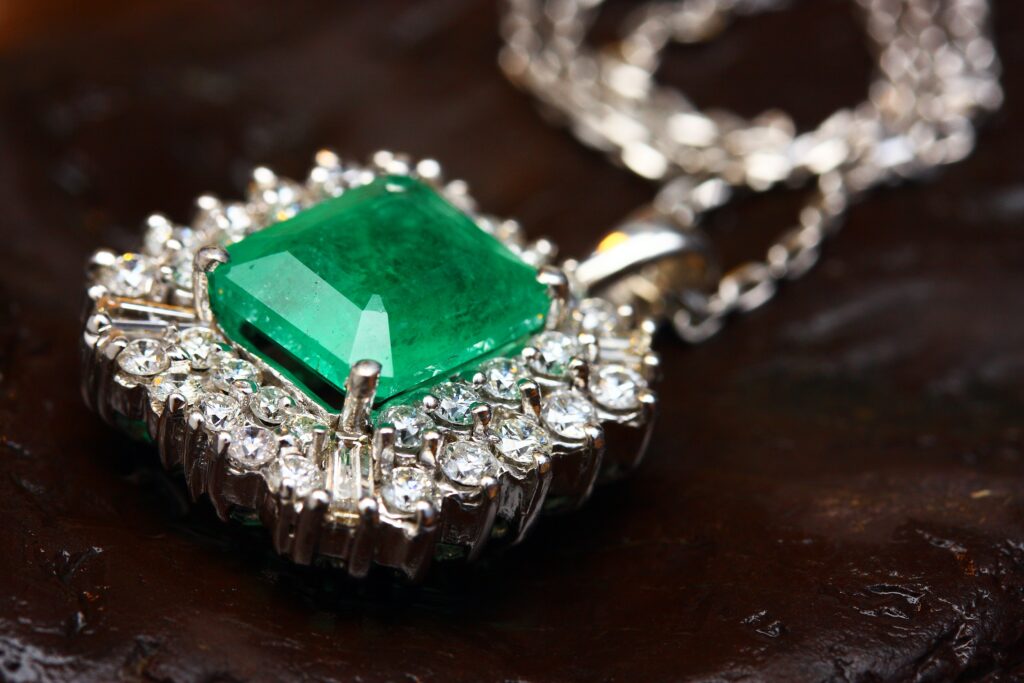
Sterling Silver & Emerald
w/ Diamond Accent Ring |
Compared with other precious stones the emerald in its
occurrence in nature is unique, for it is found in the rock in which it was formed. Unlike
diamonds, sapphires and rubies, it never occurs in gem gravels. The earliest known
locality where emeralds were found was in Upper Egypt near the coast of the Red Sea. The
best stones, however, are found in Columbia, South America. Fine specimens have also been
found in the United States in North Carolina.
While the usual shade of color seen in emeralds is alluded
to as emerald green, there are other shades, such as grass green, sea green and green
slightly tinged with yellow. The shades most highly valued are those of an intense fresh
green sometimes compared with that seen in a meadow in spring.
Beryl is a mineral known to gem lovers under several
different names, the most valued of which is the Emerald. The mineral beryl composing the
various gems is practically the same in composition, hardness, and other properties, and
the gems may be differentiated only by their color. In composition beryl is a silicate of
aluminum and glucinum. On the scale of hardness beryl is graded 7 ½ to 8, and is thus
much softer than the diamond, ruby, or sapphire. It is owing to this fact that the emerald
scratches easily and that care must be taken that when worn it is not subject to chafing
by diamonds or other harder gems.
Beryl as a mineral is of quite common occurrence, and the
crystals of the mineral in its cruder form often grow to enormous size. There is one such
single crystal preserved in the Boston Museum of Natural History, which is three and one
half feet long and three feet wide and weighs several tons.
Beryl in this common form occurs in many localities, but
the mineral in its rarer form of emerald is comparatively of very rare occurrence. The
emerald or green beryl, as it should be scientifically known, has long been the most
highly prized of the green gems. In brilliancy it exceeds all other green gems excepting
only the very rare green sapphire. The most valuable specimens exhibit a vivid grass-green
shade, and it is to this color that they owe their great value. Other considerations, such
as freedom from imperfections, are quite secondary in determining the value of the stone.
In fact a perfect emerald is almost never found, and this circumstance has passed into an
Eastern simile which runs, As scarce as a perfect emerald, this being a symbol
for the acme of rarity. The emerald is light in weight and an emerald of a given size will
be about a third larger than a diamond and forty-five per cent larger than a sapphire of
equal weight. The distinctive color of the emerald is probably due to a trace of chromium
in its composition.
Fine emeralds are generally cut cushion shape with step
cutting, and in the East are often cut cabochon. Fine emeralds have advanced very rapidly
during the last few years, both on account of the growing demand of fashion for the gems
and the scarcity of really fine specimens.
Many curious legends of gigantic emeralds have been handed
down to us, principally culled from the narratives of early travelers, who thought every
transparent green stone they saw to be an emerald.
The ancients valued the emerald highly, not alone for its
beauty, but for its supposed occult properties and its marvelous power of healing all
diseases of the eyethey also believed that if the eyes of a serpent met the gleam of
the emerald, it immediately became blind. Moore alludes to this superstition in the lines:
Blinded like serpents when they gaze
Upon the emeralds virgin blaze.
The Emperor Nero, who was shortsighted, had an eye-glass
formed of an emerald, through which he gazed and gloated over the cruel sports of the
arena.
Many interesting stories are told of the first emeralds
taken by the early conquerors of Peru to Spain, and a certain Joseph D Acosta is
said to have returned to Spain in 1587 with two chests of emeralds, each of which weighed
over one hundred pounds. The truth of this story may be questioned, but it is a fact that
the stones were highly prized and much used by the Incas and Aztecs in the extraordinary
civilization which once existed in Peru. The emerald was highly prized by the ancients and
by gem lovers of the middle ages, and this accounts for many interesting legends and
superstitions relating to the gem.
As for today, the emerald is still very highly valued as
one of the most precious stones. The emerald is Mays birthstone and is a favorite
stone for fine jewelry craftsmen throughout the world.
Shop our
beautiful selection of Gemstone Jewelry.
(click here)
Precious Stones The Big Five
Part 2 The Ruby
What fairy tales of enchanted princesses and legendary
lore of the Arabian Nights does not the mere mention of the ruby conjure up to our
imagination! No stone has been more intimately connected with poetry and romance, and few
gems can compare either in beauty or value with a perfect ruby. When Solomon exclaimed
that a virtuous woman was more valuable than rubies, and Job, that the
price of wisdom is above rubies, they both mentioned what to them was the most
valuable thing in existence. And its value and rarity have not decreased since their time.
Today a perfect ruby of five carats will fetch at least five times the value of a diamond
of the same size and quality, while rubies without flaw or blemish, and of the true
pigeon-blood variety, weighing as much as ten carats, are so rare and valuable that ten
times the value of a perfect diamond would be considered a very low price to pay for so
perfect a gem.
The ruby is the oldest or first known of all precious
stones, dating far back in the early history of Chaldea and Babylonia. The finest
specimens, as well as the largest quantities, are found in Upper Burma, and at the present
time over one-half of the worlds supply comes from this locality. The rubies found
in Ceylon, Siam and Australia have not the deep rich color of the Burmese ruby which is a
shade of red slightly inclined to the purple and is often called Pigeon Blood
Ruby. The value of rubies depends upon their color and transparency.
The red sapphire or ruby is the most valuable of the
corundum family, and when found of a good color, pure and brilliant, and in sizes of one
carat and larger, it is much more valuable than a fine diamond of the same size.
Rubies and Sapphires are scientifically the same stone,
differing only in color. Corundum, the predominating mineral of both, is composed of
nearly pure alumina. The coloring substance, which differentiates rubies and sapphires, is
believed to be chromium. In the scale of hardness the gem ranks as No. 9 and is thus the
hardest of all substances excepting the diamond. Color is the most important factor in
determining the value of the ruby. The gem is always more or less imperfect, but its
freedom from bad imperfections is also important. Since fine rubies of all sizes are
extremely rare, the price increases very rapidly with an increase in size, and a fine ruby
of more than four carats commands an extraordinary price and can be said to be the most
valuable of all gems, exceeding greatly a diamond of equal weight. The color of the ruby
varies from the lightest rose tint to the deepest carmine, but the rarest and most
valuable shade is known as Pigeon Blood. This is the color of arterial blood. The ruby has
always been greatly admired, and many say that the ruby in the British Crown is the most
beautiful gem they have ever seen.
The ruby is found in limestone deposits on side hills, but
the largest quantity is found in alluvial deposits of gravel and clay in riverbeds. These
deposits are about fifteen to twenty feet below the surface and from a few inches to five
feet in thickness. This material called byon is mined or removed and put
through a washing process by which the rubies are recovered.
The genuine ruby is gotten from the mineral known as
corundum. Emery, so much used, is an impure form of corundum. The superbly blood-red color
of the perfect ruby is produced by the very tiny portions of impurity in the substance
after they have been crystallized by Natures wonderful processes. All
genuinethat is natural stones, contain certain tiny flaws and blemishes and
characteristic peculiarities. The fewer these flaws the rarer the gem. Imitation stones
get their imperfections during manufacture, and as the chemists are more careful than
Nature, these imperfections are less noticeable. By the following differences between the
real and the artificial, you can test your ruby. A real ruby contains irregularly shaped
bubbles; the imitation ruby contains bubbles that are perfectly round. Natural rubies all
have a silky sheen, due to a number of tiny parallel lines going in three definite
directions; imitation stones never have this characteristic.
While lab-created rubies and sapphires have a distinct use
in jewelry, they can never affect the sale of the real gems any more than is the case with
imitation pearls. Aside from the fact that the imitation can always be ultimately
detected, the person desiring to purchase a ruby, as a ruby, and as a work of beauty and
distinction wants a gem which he knows is one of natures rarities and is therefore
possessed of intrinsically great value. A good illustration of this fundamental feeling is
given by Mr. Zell a noted mineralogist, who says, Many perfect copies of the Sistine
Madonna have been made by good artists, the original is priceless, the copies at the most
are worth a few hundred dollars, this is the relation of a gem made in natures
laboratory to one produced by the chemist.
Today, the ruby is still considered one of the most
valuable and beautiful of the precious stones. Artisans of fine jewelry throughout the
world continue to utilize this fine gem in their creations. Ruby is the birthstone for the
month of July.
Shop our
beautiful selection of Gemstone Jewelry.
(click here)
Precious Stones The Big Five
Part 3 The Sapphire
The sapphire, protector of the innocent, celestial
guardian of truth, bringer of health and youth, symbol of the heavens and birthstone for
the month of September, is in fact the same stone as the ruby, the mineral corundum.
The blue corundum, ranging in color from the lightest blue
to deep blue and black, is the same stone as the ruby, the only difference being in the
color. The choicest color is the soft velvety blue, approaching the cornflower in shade
and exhibiting that color vividly by artificial as well as by natural light. The
deeper-colored stones are known as male, and the light-colored ones as female sapphires.
Although choice sapphires are rare, a much greater quantity of good and large stones are
to be had than of rubies, and therefore the price of a large sapphire does not advance in
the same proportion as the price of a large ruby.
The word sapphire which means blue is of the
same form in nearly all the early tongues, thus showing that they were in use by the
ancients. Sapphires are found in many parts of the world and are usually found in the same
locality as the ruby. The largest number and finest quality of these stones come from
Thailand and India, and are found and recovered in much the same way as the ruby.
The sapphire is next to the diamond in hardness and it is
this quality that makes it impervious to wear and insures its sharp edges and corners
against years of use. Like the ruby the value of the sapphire is determined by its color.
The finest stones are a deep blue and the deeper the color the more highly it is prized if
its translucency is not impaired. Although the sapphire with its many shades of blue is
considered the most desirable stone, it is also found in other colors such as red, green,
yellow and pink.
The Oriental emerald or green sapphire does not approach
the beryl or true emerald in depth of color, but because of its superior hardness and
brilliancy, added to its extreme rarity, it is the most valuable of green gems. The
Oriental amethyst or purple sapphire sometimes reflects a red color by artificial light,
and is valued highly as a gem stone; the common amethyst is softer, less brilliant, and
loses by artificial light. The various other colored sapphires, such as yellow or Oriental
topaz, light green or Oriental aquamarine, greenish-yellow or Oriental chrysolite, and
aurora red or Oriental hyacinth, are all valuable as gem stones when they are pure, well
cut, and have pronounced colors in fact, the name Oriental is given to distinguish
the corundums from the less valuable minerals of the same colors which they resemble, but
which they greatly surpass in beauty and value because of their brilliancy and superior
hardness.
Asterias or star stones are corundums of three different
colors; the star sapphire proper is a grayish blue, the star ruby red, and the star topaz
yellow. These stones are usually cut cabochon or convex, and display under the rays of the
sun, or when exposed to one candle or other artificial light, a beautiful star with six
points. This star is produced by foreign substances in the corundum, and the lapidary
brings about the regular effect by cutting a pointed carbuncle so that the center of the
star begins at the apex, and the six bright stripes radiate to the base of the stone. The
bright lines of the star following the light move over the surface of the stone and
produce a remarkable effect. These stones are amongst the most wonderful of mineral
productions, and good specimens are very valuable. The corundum cats-eye, called
Oriental girasol or sunstone, has a bluish, reddish, or yellowish reflection of light of a
lighter shade than the stone itself, and which moves on the convex surface of the stone
like the lines of a star stone.
To this day, sapphire is one of the most important members
of the family of gems and is certainly one of the most favored by jewelry artisans
worldwide. Consequently, there is more hanky-panky with treatments, alteration
of color and various other techniques to disguise or improve flaws etc., than almost any
other precious stone. Buyer beware of bargains that look too good to be true.
Deal with reputable jewelers both online and offline. The sapphire is the birthstone for
September.
Shop our
beautiful selection of Gemstone Jewelry.
(click here)
Precious Stones The Big Five
Part 4 The Diamond
The diamond is generally regarded as the premier gem in
the world of precious stones.
Of all the precious stones the diamond has the simplest
composition; it is merely crystallized carbon. The most common substance that is known, a
substance that is present in every plant, animal and mineral on the earth.
Diamonds come mostly from the mines in South Africa, but
are also found in Brazil, India, Australia and even in the United States.
The diamond is the hardest substance known, being #10 on
the Mohl scale, despite its hardness, the diamond is not indestructible; diamond
will cut diamond; it can be burned in the air, being carbon and will leave behind carbon
dioxide gas.
The facets of a cut diamond can be worn away to some
extent by the constant rubbing of clothing. The diamond is also brittle, and can fracture
if struck against a hard surface.
Diamonds have a wide range of color; most numerous are the
whites, yellows, and browns in a great variety of shades; then come the greens; red stones
of strong tints are very rare, as are also blue, which have been found almost exclusively
in India; other tints of occasional occurrence are garnet, hyacinth, rose, peach-blossoms,
lilac, cinnamon, and brown; black, rarities. Diamonds without tint or flaw are rare indeed
and even most of the worlds famous diamonds have imperfections.
The origin of the diamonds name is the Greek word
adamas, meaning unconquerable; from the same root spring our words adamant and adamantine.
The origin of the diamond, according to classical
mythology, was its formation by Jupiter, who transformed into stone a man, Diamond of
Crete, for refusing to forget Jupiter after he had commanded all men to do so.
The Facts About Diamonds
A diamonds value is based on four criteria: color,
cut, clarity, and carat. The clarity and color of a diamond usually are graded. However,
scales are not uniform: a clarity grade of slightly included may represent a
different grade on one grading system versus another, depending on the terms used in the
scale. Make sure you know how a particular scale and grade represent the color or clarity
of the diamond youre considering. A diamond can be described as flawless
only if it has no visible surface or internal imperfections when viewed under 10-power
magnification by a skilled diamond grader.
As with other gems, diamond weight usually is stated in
carats. Diamond weight may be described in decimal or fractional parts of a carat. If the
weight is given in decimal parts of a carat, the figure should be accurate to the last
decimal place. For example, .30 carat could represent a diamond that weighs
between .295 - .304 carat. Some retailers describe diamond weight in fractions and use the
fraction to represent a range of weights. For example, a diamond described as 1/2 carat
could weigh between .47 - .54 carat. If diamond weight is stated as fractional parts of a
carat, the retailer should disclose two things: that the weight is not exact, and the
reasonable range of weight for each fraction or the weight tolerance being used.
Some diamonds may be treated to improve their appearance
in similar ways as other gemstones. Since these treatments improve the clarity of the
diamond, some jewelers refer to them as clarity enhancement. One type of treatment -
fracture filling - conceals cracks in diamonds by filling them with a foreign substance.
This filling may not be permanent and jewelers should tell you if the diamond youre
considering has been fracture-filled.
Another treatment - lasering - involves the use of a laser
beam to improve the appearance of diamonds that have black inclusions or pots. A laser
beam is aimed at the inclusion. Acid is then forced through a tiny tunnel made by the
laser beam to remove the inclusion. Lasering is permanent and a laser-drilled stone does
not require special care.
While a laser-drilled diamond may appear as beautiful as a
comparable untreated stone, it may not be as valuable. Thats because an untreated
stone of the same quality is rarer and therefore more valuable. Jewelers should tell you
whether the diamond youre considering has been laser-drilled.
Imitation diamonds, such as cubic zirconia, resemble
diamonds in appearance but are much less costly. Certain laboratory created gemstones,
such as lab-created moissanite, also resemble diamonds and may not be adequately detected
by the instruments originally used to identify cubic zirconia. Ask your jeweler if he has
the current testing equipment to distinguish between diamonds and other lab-created
stones.
Diamond jewelry: diamond rings, diamond earrings, diamond
pendants and diamond bracelets are some of the most sought after gemstone creations. Your
eyes tell you how beautiful a piece of diamond jewelry is, but how do you know you are
getting your moneys worth?
A little knowledge can go a long way to help you purchase
a beautiful piece of diamond jewelry at a fair price.
When shopping for diamond jewelry online, apply these
tips.
Shop with companies you know or do some homework before
buying to make sure a company is legitimate before doing business with it.
Take advantage of information and referrals from an
Internet company you have come to trust.
Get the details about the product, as well as the
merchant's refund and return policies, before you buy.
Look for an address to write to or a phone number to
call if you have a question, a problem or need help.
Shop our
beautiful selection of Gemstone Jewelry.
(click here)
Precious Stones The Big Five
Part 5 The Pearl
Since pearls are so rare and possess such a high degree of
natural beauty, they have been considered to be among the most splendid of gems for many
centuries.
The people of India and Persia (Iraq) were among the
earliest to collect pearls, because of the rich fisheries of Ceylon and the Persian Gulf,
the Indian and Persian princes in the last century, acquired huge collections of pearls
that have never been equaled, these collections would be worth hundreds of millions of
dollars today.
Pearls A Natural Wonder
Natural or real pearls are made by oysters and other
mollusks. Cultured pearls also are grown by mollusks, but with human intervention; that
is, an irritant introduced into the shells causes a pearl to grow. Imitation pearls are
man-made with glass, plastic, or organic materials.
Because natural pearls are very rare, most pearls used in
jewelry are either cultured or imitation pearls. Cultured pearls, because they are made by
oysters or mollusks, usually are more expensive than imitation pears. A cultured
pearls value is largely based on its size, usually stated in millimeters, and the
quality of its nacre coating, which give it luster. Jewelers should tell your if the
pearls are cultured or imitation. Some black, bronze, gold, purple, blue and orange
pearls, whether natural or cultured, occur that way in nature; some, however, are dyed
through various processes. Jewelers should tell you whether the colored pearls are
naturally colored, dyed or irradiated.
Clams, oysters, mussels and many other mollusks with limy
shells are known to produce pearls. But very few kinds yield gem pearls of jeweler's
quality. The pearl is an abnormal growth of mother-of-pearl, or nacre, imbedded in the
soft bodies of these shellfish. It is built up, layer upon layer, in the same way as nacre
is added to the lining of the growing shell and always has the same color and luster. For
example, over the country, hundreds of good-sized pearls are found each year in the
oysters we eat. Unfortunately these have no commercial value regardless of whether they
have been cooked or not because they are dull opaque white or purple like the shell of the
parent oyster. In recent times almost all pearls of gem quality come from the oriental
pearl oyster which has a bright shimmering translucent nacre.
A pearl starts growing when some irritating foreign
substance such as a sand grain, bit of mud, parasite or other object becomes lodged in the
shell-producing gland called the mantle. Pearls formed in the soft flesh where nacre can
be added on all sides are most likely to be spherical and the most highly prized. By far
the great majority are flattened or variously distorted and have little value. Size,
color, luster and freedom from flaws are other essential qualities. Unlike other gems,
such as diamonds, pearls have an average life of only about 50 years. In time the small
amount of water in a pearl's make-up is lost and its surface cracks. Because they are
mostly lime, necklaces which are worn often are injured by the acid secretions of the
human skin.
Though, the pearl is not technically a stone at all,
its beauty has earned it a place in the Big 5 of precious stones. Jewelry artists
have long appreciated the pearl and continue to utilize its charm in their creations
Buying pearl jewelry can be fun, exciting and confusing.
Whether youre considering a gift of pearl jewelry for someone special or as a treat
for yourself, take some time to learn the terms used in the industry.
Pearl jewelry: pearl rings, pearl earrings, pearl pendants
and pearl bracelets are some of the most sought after jewelry creations. Your eyes tell
you how beautiful a piece of pearl jewelry is, but how do you know you are getting your
moneys worth?
A little knowledge can go a long way to help you purchase
a beautiful piece of pearl jewelry at a fair price.
When shopping for pearl jewelry online, apply these tips.
Shop with companies you know or do some homework before
buying to make sure a company is legitimate before doing business with it.
Take advantage of information and referrals from an
Internet company you have come to trust.
Get the details about the product, as well as the
merchant's refund and return policies, before you buy.
Look for an address to write to or a phone number to
call if you have a question, a problem or need help.
Shop our
beautiful selection of Pearl Jewelry.
(click here)
The Pearl Necklace A Timeless Beauty
It has been said that of all the pieces of jewelry in the world, a
pearl necklace is the only thing that a woman should not be without. And thats no
wonder, for a pearl necklace is the embodiment of classic sophistication and timeless
elegance. It goes with a variety of outfits, from casual day wear to formal evening
attire. And depending on the type of pearl and color, there are various pearl necklace
styles suitable for the very young, those enjoying their golden years, and almost everyone
else in the middle.
The price of a pearl necklace depends on the quality of its pearls.
Saltwater pearls are generally more expensive than freshwater ones, which are cultured.
The sheen and the thickness of the pearls nacre also affect the price, as well as
the size and roundness of the pearls themselves. Pearl necklaces of various colors are
available on the market. Smaller pearls in light hues of blue or pink are usually more
suitable for young children, while the creamier, ivory-toned pearls are preferred by older
women. Jewelry pieces made from black pearls are very, very expensive, since these pearls
are so rare.
According to Chinese folklore, pearls are the tears of a dragon. In
Roman mythology, they are the tears of Venus. Jewelry designers, in their tireless efforts
to do justice to the legendary beauty of these gems, have been adding their own twists to
the pearl necklace. Aside from the classic strand, the pearls used in necklaces are
sometimes set in gold, silver or platinum. Some designers also mix pearls with other gems
to create a unique effect. Extra ornaments, such as charms or a brooch, can also be
attached to a pearl necklace to give it a personalized flair.
Caring for a pearl necklace does not involve a lot of fuss. The most
advisable thing to do is to wear it often, because if its stored away for long
periods of time, it will dry up and lose its sheen. The bodys natural oils will keep
the pearls looking lustrous and fresh. Its also important to avoid having the pearls
come in contact with substances such as hair spray or body lotion, since these can also
adversely affect the pearls condition.
The popularity of the pearl necklace has never waned both among
ordinary people and societys elite. The quintessential fashion plate, Jackie
Kennedy, had a passion for pearls; so does actress Maria Berenson. Other celebrities often
photographed wearing pearl necklaces are Michelle Pfeiffer, Sophia Loren, Jennifer Lopez
and Paris Hilton. The versatility of pearls is such that fashion experts are even
predicting an increase in the number of men who will start wearing pearl-accented dress
accessories. For now, however, there is very little to surpass the elegance of the sight
of a pearl necklace gracing the neckline of a woman, whether shes a celebrity or
not.
Shop our
beautiful selection of Pearl Jewelry.
(click here)
Opal Jewelry Your Own Personal Piece of Rainbow
Opal is a magnificent gemstone whose shades encompass virtually every
hue in the color spectrum. The play of color is different on every stone, and its
shimmering hues gave rise to the word opalescent. Because it is such an
entrancing and unique gemstone, it is no wonder that opal jewelry is very popular among
collectors and fashion enthusiasts.
Opal is the birthstone for October and its history is peppered with
superstitions and beliefs that it caused both good luck and bad luck. In Europe, it used
to be thought of as the official stone of thieves and robbers. One of the
greatest contributors to the myth that opal jewelry causes misfortune is a misreading of
its depiction in Sir Walter Scotts 19th-century novel Anne of
Geierstein.
However, many cultures associate the opal with white magic and good
fortune. The ancient Romans used opal jewelry as talismans and for them, it symbolized
purity and hope. The ancient Greeks, on the other hand, believed that it gave the wearer
the abilities to prophesy or foretell the future. It was also thought to bring luck to the
wearer.
The popularity of opal jewelry is on the rise. Although it is
classified as a semi-precious stone, the black opal can cost as much as a diamond. Opals
can also range in price, depending on their color. Generally, red opals are the most
expensive while blue opals are the least. Also, doublet or triplet opal jewelry, or a
piece of opal that is sandwiched between two other materials is less expensive than solid
opal pieces. Set in gold or silver, or embellished with other gemstones, there is a wide
variety of opal jewelry to choose from.
Men and women throughout time have been fascinated and captured by the
iridescent colors of opal jewelry. Bad or good luck notwithstanding, these multi-colored
gems are worthy additions to any wardrobe. A person cannot be blamed for thinking that
wearing an opal necklace, earrings, bracelet or ring is somehow just like having a piece
of the rainbow close to the skin.
Shop our
beautiful selection of Gemstone Jewelry.
(click here)
Gemstone Color and Mystical Symbolism
The universe of colored gemstones is endlessly
fascinating, for centuries, nearly every culture has held the belief that colored stones
possess magical powers or the ability to endow the wearer with certain attributes. Due to
the magical powers associated with colored gems, they were used extensively as amulets and
talismans, portals to the future; and as important components to many spiritual practices.
Yellow stones when worn by a woman were a sign of
generosity. Worn by a man, a yellow stone signaled secrecy (as with a secret lover).
A violet stone worn by a woman indicated lofty thoughts
and love of a spiritual nature. For a man, sober judgment, steadfastness, and ambition.
Black stones revealed foolishness and capriciousness in
young women, while in married women it showed fidelity, constant love and perseverance. A
man wearing a black stone exhibited gravity, common sense, constancy, and inner strength.
Red stones when worn by a women indicated pride,
haughtiness, and obstinacy. On a man nobility, command, leadership and vengeance.
Blue stones on a woman exposed jealousy in love, vigilance
and social correctness. A man wearing blue stones meant wisdom, lofty thoughts and
generosity.
Green stones for a woman meant unfounded ambition,
childish delight, and change. Green stones for a man meant joy, lost friendship, and
transitory hope.
In our modern world, gemstones are worn primarily for
their inherent beauty. An almost endless choice of colors are available.
Red rubies, garnets, red tourmalines, red diamonds
and spinels. Blue topaz, blue tourmaline, blue spinel, tanzanite, iolite and even
blue diamonds.
Green emeralds, green garnet (tsavorite) green
tourmalines, peridots, green zirconia and diamonds
and so on
Today the possibilities for self-expression with colored
stones are seemingly endless with choices in every price range and for every taste.
Whether for fashion, fun or to express your inner feelings, everyone should enjoy the
bounty of colorful stones that nature has provided.
Shop our
beautiful selection of Gemstone Jewelry.
(click here)
Gem and Crystal Jewelry The Power to Heal?
References to the power of crystals and gems and their use
in spiritual and healing rituals can be found in the ancient Mayan and Hebrew
civilizations. Today the practice of using stones and crystals continues with ordinary
people across the world who claim extraordinary results.
By stimulating a person's thought, it is believed that
crystals stimulate healing both physical and non-physical. Stones in the red family
red, yellow and orange are prized for their ability to produce energy. On
the other end of the spectrum, blue, violet, and lavender stones have a calming effect. In
between are the clear and aquamarine stones that having healing properties.
Many people use and combine crystals to improve a variety
of physical, mental, and spiritual conditions based on the healing properties attributed
to each stone:
- Amethyst This "spiritually uplifting" stone can reduce anger, and
impatience.
- Aquamarine This beautiful stone protects your heart and your immune system and
aids communications on all levels
especially on the physical and spiritual planes.
- Carnelian The perfect stone for targeting your body's system, carnelian is a
"stimulant" for your circulatory system, kidneys, appetite, emotions, and
sexuality. It bestows confidence, assertiveness, and an unstoppable drive to succeed.
- Citrine Citrine can help with acid indigestion, food disorders, and allergies
with cleansing powers aimed at your spleen, kidneys, liver, urinary system, and
intestines. Mentally, citrine is valuable for emotional clarity, willpower, optimism, and
self-discipline.
- Coral Use coral to strengthen your muscles and spine, and to promote bone and
tissue regeneration. When it comes to your feels, coral can enliven and enrich your
experience of emotions.
- Diamond A symbol of prosperity and love, diamonds increase personal clarity,
trust, and confidence. They also amplify your thoughts and allow you to expand your
strengths and positive attitudes.
- Emerald You'll breathe easier thanks to the positive effect of emeralds on your
respiratory system. Emeralds can also help you get a good night's sleep and are believed
to reduce the pain of childbirth.
- Jade The crystal of choice for courage, knowledge, justice, compassion, emotional
balance, humility, generosity, harmony, wealth, and long life.
- Lapis Anxiety, restlessness, insomnia, shyness, nervous system, speech, hearing,
pituitary, inflammation, pain. Mind expansion, intuition, creativity, spiritual
connection. Organize, quiet the mind.
- Malachite Let go with malachite. Use it to release pain, reduce inflammation, and
rid yourself of anger and depression.
- Ruby It seems only natural that the red, red ruby is valuable for blood clots,
blood cleansing, menstrual pain, and even impotency. Rubies simulate circulation and
"amp up" the pituitary gland.
- Sapphire Sapphires are used to reduce inflammation, lower fevers, and put an end
to nosebleeds. They are also valuable for helping you tap into your intution.
Shop our
beautiful selection of Gemstone Jewelry.
Birthstone Origins – Stranger than Fiction
In the Old Testament, the book of Exodus tells the story
of the Breastplate of Aaron, used in religious ceremonies. (Aaron
just in case you
were absent from Sunday school that day
was the Biblical figure who performed, at
Moses' direction, the miracles that confounded Pharaoh and his magicians.)
Aaron's breastplate was adorned with four rows of
gemstones, three gemstones in each row, in the following pattern: Sardius, topaz,
carbuncle; emerald, sapphire, diamond; ligure, agate, amethyst; beryl, onyx, jasper. These
twelve gemstones represented the twelve tribes of Israel. The twelve positions were later
co-opted by astologers who linked them to the twelve months of the calendar year and the
twelve signs of the zodiac.
The Traditional Birthstone List contains these older
birthstones and represents birthstone traditions heralding back to the 15th century. The
Modern Birthstone List was created by the National Association of Jewelers in 1912 in
Kansas City, Missouri. Gemstone purists complained that the NAJ list was devised solely
for commercial purposes (they probably didn't believe in Santa Claus either!). As a
result, astrologers who prescribed gems often substituted alternate or secondary stones.
The Mystical Birthstone list below originated in from Tibet over a thousand years ago. The
Ayurvedic Birthstone list is derived from age-old Ayurvedic Indian Medicine, a practice of
native people for more than a century.
| Month |
|
Modern |
|
Traditional |
|
Mystical |
|
Ayurverdic |
| January |
Garnet |
Garnet |
Emerald |
Garnet |
| February |
Amethyst |
Amethyst |
Amethyst |
Bloodstone |
| March |
Aquamarine |
Bloodstone |
Jade |
Bloodstone |
| April |
Diamond |
Diamond |
Opal |
Quartz |
| May |
Emerald |
Emerald |
Sapphire |
Agate |
| June |
Pearl |
Alexandrite |
Moonstone |
Pearl |
| July |
Ruby |
Ruby |
Ruby |
Ruby |
| August |
Peridot |
Sardonyx |
Diamond |
Sapphire |
| September |
Sapphire |
Sapphire |
Agate |
Lapis Lazuli |
| October |
Opal |
Tourmaline |
Tourmaline |
Jasper |
| November |
Yellow Topaz |
Citrine |
Citrine |
Pearl |
| December |
Turquoise |
Lapis Lazuli |
Onyx |
Ruby |
|
Astrologically speaking, your place on the Zodiac is more
meaningful than your birth month for tapping into your "power," which has led to
the creation of the following list of "Star Stones" related to the star under
which you were born, rather than the day.
| Capricorn (Dec.
22 Jan. 19) |
Ruby, Agate, Garnet |
| Aquarius (Jan. 20 Feb. 18)
|
Garnet, Moss Agate, Opal, Amethyst |
| Pisces (Feb. 19
Mar. 20) |
Rock Crystal, Sapphire,
Amethyst, Bloodstone |
| Aries (Mar. 21 Apr. 19)
|
Bloodstone, Diamond |
| Taurus (Apr. 20
May 20) |
Sapphire, Turquoise,
Amber, Blood Coral, Emerald |
| Gemini (May 21 Jun. 20)
|
Agate, Chrysoprase, Pearl |
| Cancer (Jun. 21
Jul. 22) |
Emerald, Moonstone, Pearl,
Ruby |
| Leo (Jul. 23 Aug. 22)
|
Tourmaline, Sardonyx, Onyx |
| Virgo (Aug. 23
Sep. 22) |
Jasper, Carnelian, Jade,
Sapphire |
| Libra (Sep. 23 Oct. 22)
|
Opal, Lapis Lazuli, Peridot |
| Scorpio (Oct. 23
Nov. 21) |
Aquamarine, Topaz |
| Sagittarius (Nov. 22 Dec.
21) |
Sapphire, Amethyst, Turquoise, Topaz |
|
So whether you choose an emerald from the Breastplate of
Aaron, a moonstone from Tibet's mystical birthstone list, an opal for its ayurvedic
birthstone properties, or your very own "star sign" representative
may the
force (of the birthstone) be with you!
Shop our
beautiful selection of Birthstone Jewelry.
(click here)
Birthstone Jewelry Beliefs and Celebrity Birthdays
Wearing birthstone jewelry is very popular today. Not only
is it fashionable; somehow, it also makes the item feel more personal and part of the
wearers personality. Almost all gems are believed to be imbued with some special
sort of power and this is one of the reasons why it is considered lucky to wear birthstone
jewelry. Lets look at some of the mystical properties and beliefs about these
special gems and some famous people who would wear them.
Januarys birthstone, the garnet, is believed to have
blood purification properties and to protect against poisoning. Actress Faye Dunaway and
supermodel Kate Moss are two celebrities who were born in January.
The amethyst, the gem of the month for February, is a
symbol of serenity and peace. In addition, its reputed to protect the wearer from
intoxication. Princess Stephanie of Monaco, singer Roberta Flack and actress Drew
Barrymore have amethysts in their birthstone jewelry.
|